
(by Pam Hunt)
Like many of our long-legged wading birds, the Glossy Ibis is predominately a species of the New Hampshire coast. Although it can be seen here from April through early September, it has never bred in the state. Instead, the birds we see mostly come from nesting colonies in Maine (including Appledore Island in the Isles of Shoals). In spring, New Hampshire also sees overshoots as birds are migrating north, and this is the time of year when ibis are mostly likely in the major river valleys. In recent years, both the numbers of Glossy Ibis along the coast and the number of spring vagrants inland have increased, probably a direct result of the Appledore colony being reestablished after a long absence. All nesting herons abandoned the island between 2001-2003 when raccoons were introduced. Although the raccoons were removed in 2004, the herons did not return to nest on Appledore until 2020. In 2026 there has even been a White-faced Ibis, the species native to western North America, mingling with the native Glossies.
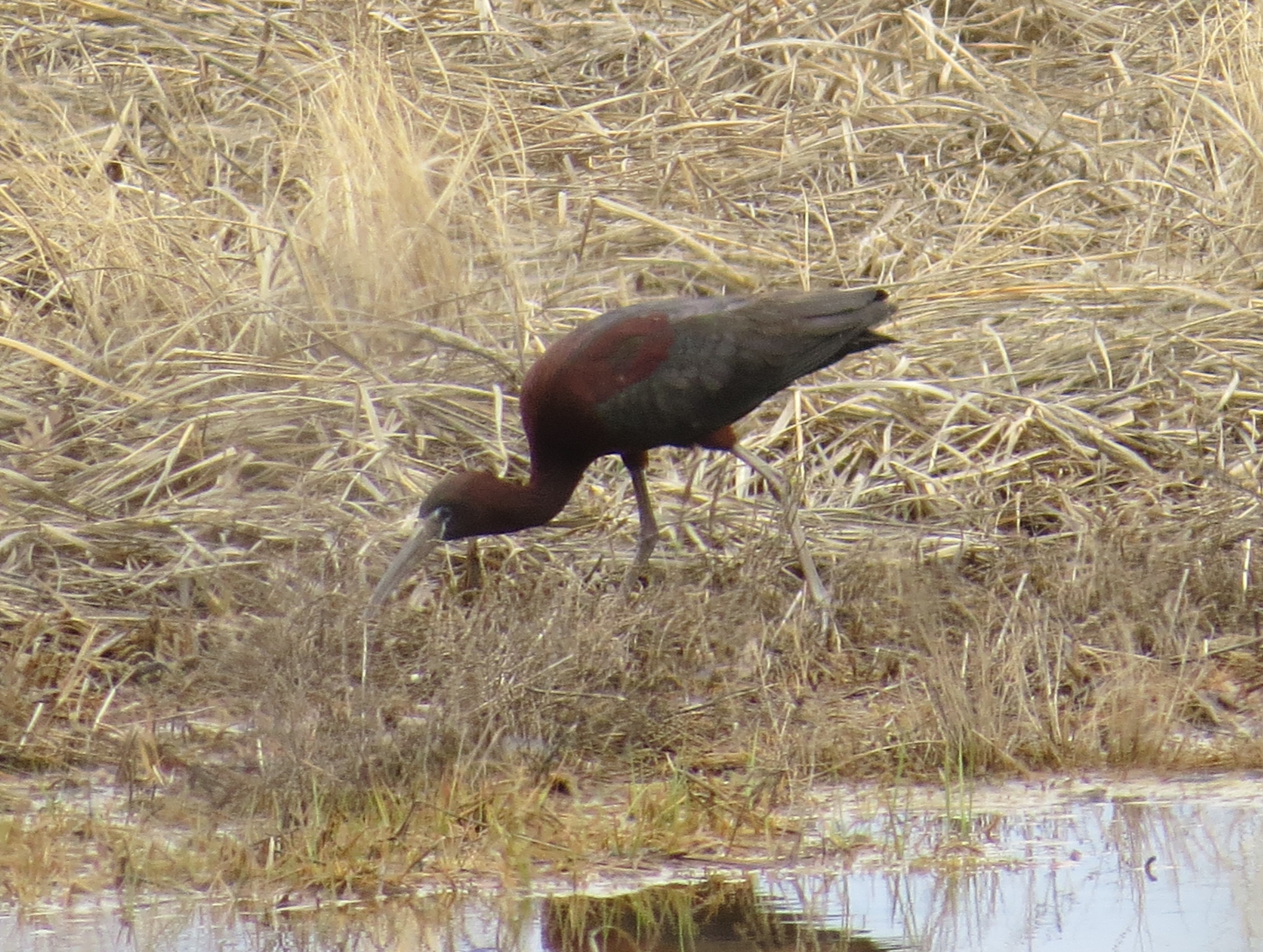 The Glossy Ibis is relatively new to the Western Hemisphere, apparently having colonized northern South America from Africa in the early 1800s. From these original storm-blown vagrants, the species increased and spread north as far as the Gulf of Maine, and west along the Gulf of Mexico. In the New World it is almost entirely a coastal species, although it occurs inland elsewhere in its extensive breeding range. It is one of a handful of bird species found on all continents except Antarctica.
Although related to herons and egrets, ibis are in a family all their own. The most obvious difference is in their bills, which are decurved instead of straight and pointed. The bill is sensitive to touch, and ibis spend a considerable amount of time using them to feel for food rather than hunting visually. They either probe in mud or sweep the bill back and forth in the water, hoping to contact a worm, clam, or insect larva, at which point they quickly snap it up. Sometimes ibis are seen foraging on dry land (e.g., grassy fields), in which cases they will add insects such as grasshoppers to their diet, as well as a few seeds.
State of the Birds at a Glance:
- Habitat: Coastal
- Migration: Medium distance
- Population trend: Stable or increasing
- Threats: Wetland loss, Human disturbance
- Conservation actions: Minimize human disturbance, Protect coastal habitats
More information on “The State of New Hampshire’s Birds” is available here. Full species profiles in the format of “Bird of the Month” are now available here.