
(by Pam Hunt)
House wrens are most famous among backyard birders for two things: their enthusiastic bubbling song and willingness to use almost any semi-enclosed space as a nest site. Song has been extensively studied in this species, in terms of both how it developed and how it is used. Males have dozens if not over 100 different versions of the song in their repertoires, and most of these are unique to individuals. Early in the breeding season song is primarily directed at other males for territory defense but shifts to female-focused after pairing. As the pair prepares to initiate a nest, the male gradually reduces his volume, in extreme cases producing a barely audible song without opening his bill. This quiet period coincides with the timing of mating, and it probably minimizes the chances of attracting other males to a receptive female. Females sing as well, but their songs are shorter and far less complex.
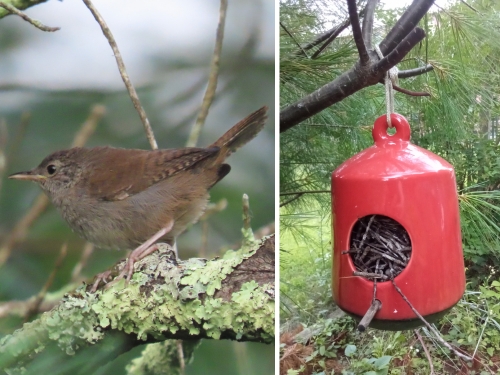 While historically Northern House Wrens (Troglodyes aedon) nested exclusively in natural cavities, including those left by woodpeckers, they quickly adapted to structures provided – intentionally or otherwise – by humans. Unlike bluebirds and Tree Swallows, they are not terribly picky about the dimensions of bird houses and will also nest in “cavities” as varied as watering cans, old shoes, and anything else they can stuff with sticks. It is these sticks that are a solid clue that a Northern House Wren has taken up residence, since our other common cavity nesting birds (bluebirds, Tree Swallows, chickadees) tend to restrict their materials to a modest cup of grass or moss at the bottom of their chosen site. A male wren will often build multiple nests within his territory, even though his mate will ultimately pick only one.
One downside of having wrens in your yard is that they are often aggressive towards other cavity nesting birds. They will try to evict species much larger than themselves (e.g., bluebirds), sometimes even escalating to tactics such as piercing other species’ eggs. To minimize such competition (and you have the space) you can place boxes as far from a forest edge as possible (ideally 100 feet), since while they may be bullies, Northern House Wrens are reluctant to travel far from cover.
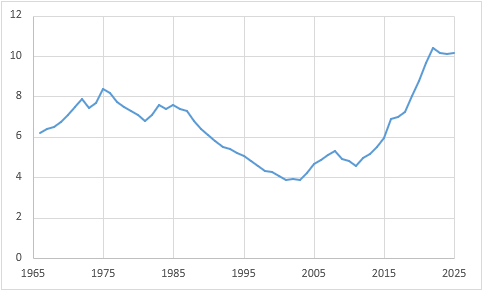
Northern House Wren populations are generally increasing across most of North America, although much recent growth follows a sharp decline during the 1990s (Figure 1). It’s not clear what might have been behind the decline, especially since this species is so adaptable and tolerant of humans. Studies in western North America have found short-term population declines during droughts or after cold winters, but no such factors were sustained for over a decade to influence birds in New England.
Taxonomic Note: In case you’re wondering why the “Northern” was added to this species name, in 2024 ornithologists determined that the species formerly known as “House Wren” was actually seven species spread across the Western Hemisphere. The Northern House Wren is the only one of these to occur in the United States. It is replaced from southern Mexico through the tip of South America by the Southern House Wren, and there are five species endemic to islands in the Caribbean.
State of the Birds at a Glance:
- Habitat: Developed, Shrublands
- Migration: Short distance
- Population trend: Increasing/Variable
- Threats: Predation, Collisions
- Conservation actions: Maintain a bird-friendly yard
More information on “The State of New Hampshire’s Birds” is available here. Full species profiles in the format of “Bird of the Month” are now available here.