
(article and photos by Diane De Luca)
Among the earliest signs of spring in New England’s forests is the quiet emergence of trailing arbutus (Epigaea repens), a low-growing native plant with delicate, fragrant pink-and-white blossoms. Tucked close to the forest floor, often hidden beneath last year’s leaves, this unassuming plant rewards those who look closely, and patiently, for the first blooms of the season.
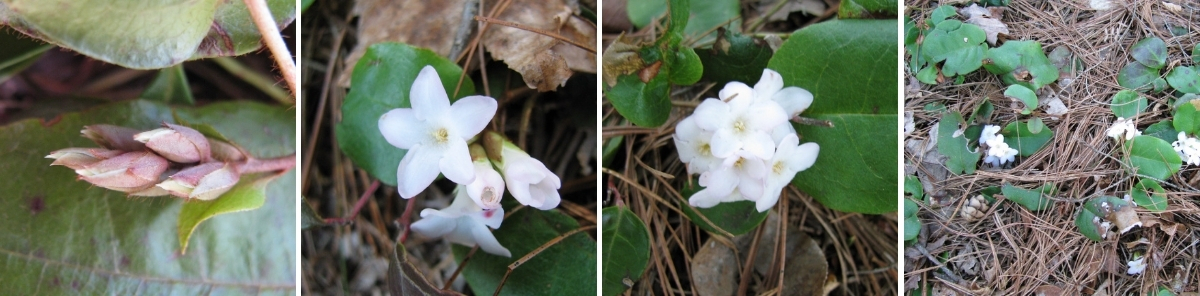
Steeped in history and folklore, trailing arbutus is commonly known as the “Mayflower.” According to legend, it was one of the first flowering plants observed by Pilgrims after their first harsh winter in Plymouth Colony. Its early blooms came to symbolize hope and renewal, a meaning that still resonates today.
Trailing arbutus is a member of the heath family, related to blueberries and rhododendrons. It forms evergreen, creeping mats along the forest floor, favoring dry, acidic soils beneath pine and oak forests. Its leathery leaves persist through the winter, and remarkably, its flower buds are formed well in advance, often visible beneath the snow, waiting for the right conditions to open.
This early blooming strategy makes trailing arbutus especially important for pollinators. Emerging native bees rely on early-season nectar sources, and the sweetly scented flowers of trailing arbutus provide a valuable food source at a time when few other plants are in bloom. In return, these pollinators help ensure the plant’s reproduction, continuing a relationship shaped over thousands of years.
But the timing of these blooms, known as phenology, is not fixed. It shifts in response to weather patterns, temperature, and broader environmental changes. Some years, trailing arbutus may flower in early April; in others, blooms may be delayed by several weeks. Late snowfalls, prolonged cold, or fluctuating spring temperatures can all influence when the tightly formed buds finally open.
Interestingly, not all plants respond to these conditions in the same way. While trailing arbutus, with its overwintering buds and evergreen leaves, is particularly sensitive to late-season cold, other spring wildflowers that emerge later may be less affected. These differences highlight the complexity of natural systems with each species responding in its own way to changing conditions.
Shifts in bloom timing can have ripple effects. If flowers open earlier or later than usual, they may become out of sync with the pollinators that depend on them. For early-season plants like trailing arbutus, this raises important questions: Will pollinators be active at the right time? Will there be enough food available when they emerge? These are the kinds of questions scientists and naturalists are working to better understand as climate patterns continue to change.
Bringing the Lesson Home: Gardening for Early Pollinators
While trailing arbutus is a treasured native plant, it is not well-suited for garden transplanting and is best appreciated in its natural woodland habitat. However, its story offers an important lesson for gardeners: early-season blooms are critical for pollinators.
You can support these early emerging bees and other insects by incorporating native plants into your landscape that provide nectar and pollen in spring. Consider species such as:
- Native blueberries (Vaccinium spp.)
- Serviceberry (Amelanchier spp.)
- Wild columbine (Aquilegia canadensis)
- Golden alexanders (Zizia aurea)
These plants, like trailing arbutus, have evolved alongside local pollinators and help bridge the seasonal gap when few other resources are available.
Gardening with native plants also means thinking beyond flowers. Leaving leaf litter, minimizing spring cleanup, and allowing stems to remain standing can provide essential nesting and overwintering habitat. In this way, your garden becomes not just a collection of plants, but a functioning ecosystem.
A Call to Observe
One of the most powerful ways to engage with the natural world is through observation. By noticing when plants bloom, when insects emerge, or when birds return, you can begin to see patterns and changes over time.
Trailing arbutus offers a perfect place to begin. Its early blooms, subtle beauty, and sensitivity to seasonal conditions make it both a harbinger of spring and a window into the dynamics of the natural world.
As you head outdoors this season, take a moment to look closely at the forest floor or your own garden. You might just catch the first hint of spring in bloom, and with it, a story that has been unfolding for generations.