
(Photo and article by Anita Fernandez)
The insect pictured above is a Net-winged Beetle. There are a few species in New Hampshire that look very similar, such as the Banded, Reticulated, End Band, or Terminal Net-winged Beetle. The depressions between the wing ridges, as well as the equal height of the wing ridges themselves, indicate that this is most likely an End Band Net-winged Beetle. Beetles have two sets of wings, but unlike other insects, the top (forewing) set is harder than the “standard” insect wing, and together they are called elytra. Some beetles have elytra that are extremely sturdy and can even survive being run over by a vehicle’s tire. However, the Net-winged beetles have more flexible wings, which lends them to more closely resemble moths than beetles. They are active at least through September and can be seen on flowering plants such as the late-blooming goldenrods and asters found in our pollinator meadow.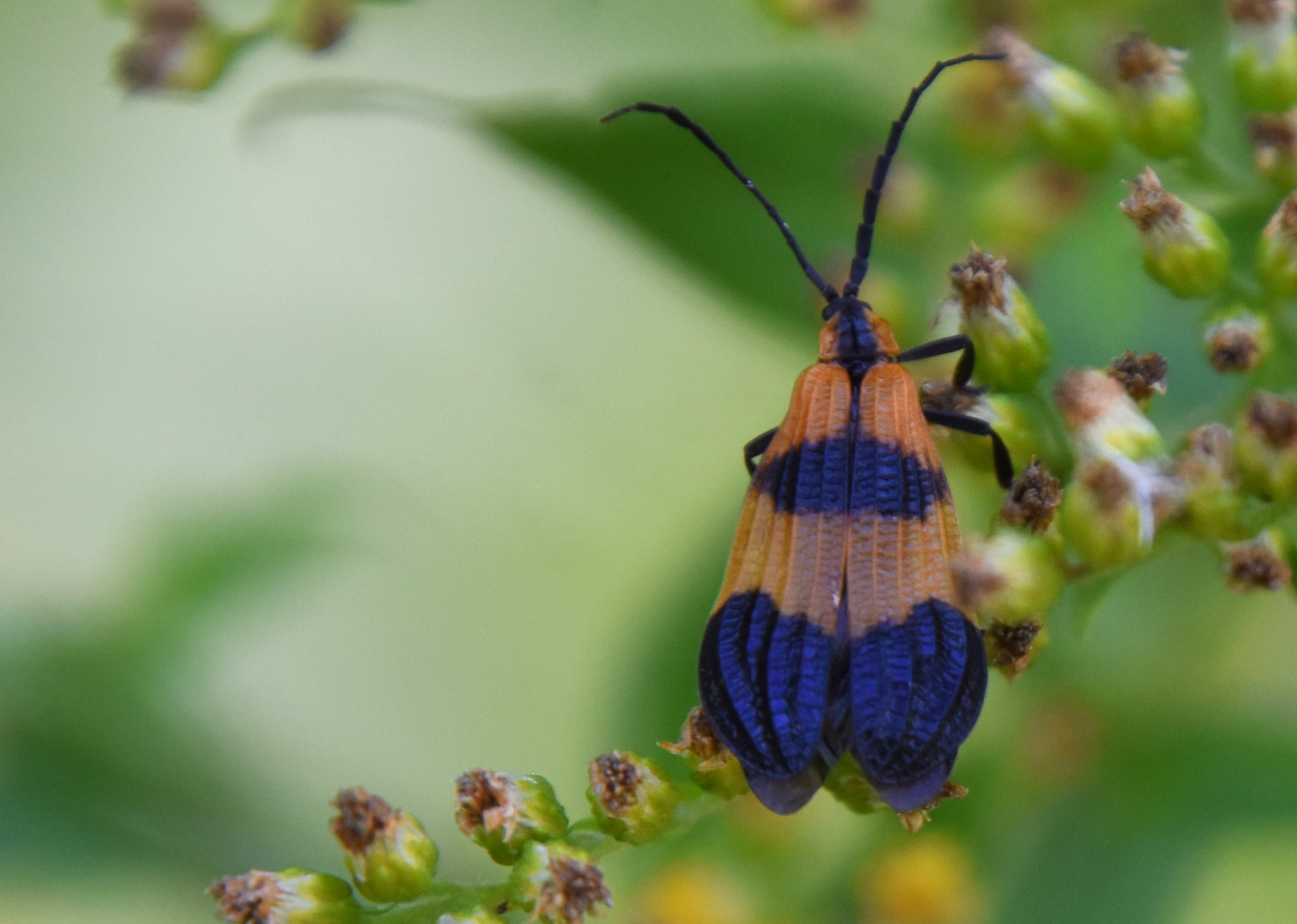
The genus name of the Net-winged beetles, Calopteron, means “beautiful wing.” Even from a distance, you can see why; these insects stand out among the flowers they land on. Given the coloration of these beetles, which is superficially similar to toxic species such as Monarchs, you may wonder if these insects are also toxic. The answer is yes, but their toxicity differs from the way Monarchs are toxic. Monarch caterpillars eat milkweeds, which contain cardenolides. These toxins stay in the caterpillars through metamorphosis, making both the caterpillars and the adults toxic. Their toxicity occurs throughout the body, so a predator who attempts to bite them will be subjected to the toxins. In the Net-winged beetles, toxins called pyrazines are produced in the wings. The beetles do not consume these chemicals directly (they eat fungi, rotting wood, and small arthropods), but synthesize these toxins within their body. The chemical is only emitted when the ridges of the wings are broken, indicating that the toxins are used in defense (to deter a predator trying to munch on the beetle, for example). Also, like Monarchs, this aposematic (warning) coloration can be a good tool for the predator to remember the foul taste of the wings and not attempt to eat another insect colored similarly. They also possess another defensive toxin that they can employ, which might be a mix of lycidic acid and pyrazines. When the beetle feels threatened, it can also ooze toxins from the gaps between its leg joints, an unpalatable liquid that can further deter predators.