
(by Pamela Hunt)
In March 2009, the White Mountain National Forest transferred a 100-acre parcel along the western boundary of Cannon Mountain Ski Area, also known as “Mittersill Ski Area,” to the New Hampshire Division of Forests and Lands. The state was interested in reviving skiing at Mittersill, but due to sensitive high-elevation spruce/fir habitat, the National Forest, Cannon, NH Fish and Game, and NH Audubon entered into a Memorandum of Understanding that the State would limit habitat alteration above 2500′ so as to minimize potential impacts to Bicknell’s Thrush. This thrush breeds only in high-elevation conifer forests in the northeastern United States and southeast Canada, and is considered a conservation priority throughout its range.
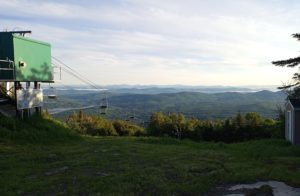
NH Audubon’s role in this project has been to conduct annual Bicknell’s Thrush surveys on both the original Mittersill parcel and an adjacent one added in 2014. Each year, a team of surveyors from NH Audubon and our partners takes the tram to the top of Cannon the night before, sleeps over at 4000′, and gets up before sunrise to listen for thrushes (and all other birds) at 11 points distributed across the study area. At the same time, we look for any changes to vegetation such as unauthorized ski trails that might alter Bicknell’s habitat.
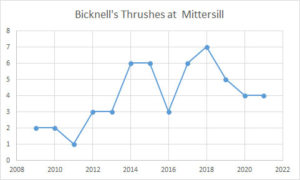 Over the 13 years that these surveys have been conducted, we’ve recorded 47 different species. The most common are a handful typical of high-elevation habitats in the White Mountains, including Yellow-bellied Flycatcher, Winter Wren, Bicknell’s and Swainson’s Thrushes, Dark-eyed Junco, White-throated Sparrow, and Magnolia, Blackpoll, and Yellow-rumped Warblers. Numbers of Bicknell’s on the original six survey points have ranged from a low of one in 2011 to a high of seven in 2018. The general trend appears to have been one of a gradual increase followed by a slight decline, as shown in the graph. Thus while the species seems to be declining globally, it’s at least holding its own on Cannon Mountain. We haven’t seen any evidence of habitat degradation or loss, so hopefully Bicknell’s will continue to be a fixture on Cannon for many years to come.
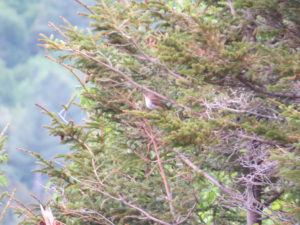
The latter may largely depend on factors that operate far outside of New Hampshire however. Virtually the entire global population of Bicknell’s Thrush spends the winter on the island of Hispaniola in the Caribbean – home to Haiti and the Dominican Republic. Here on the winter grounds, habitat loss is a significant threat, and the limited forest that remains is at risk of becoming less suitable as climate change leads to increased drought in the region. Thus, while we’ve done a good job conserving this species in its northern breeding areas, there is much work left to do before it’s “out of the woods.”