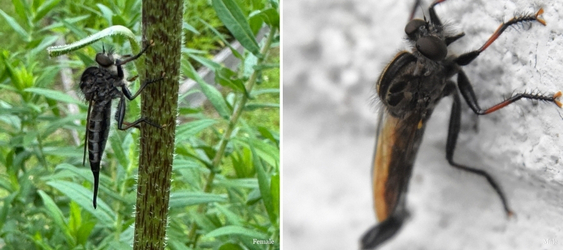
(Photos and article by Anita Fernandez)
Even fearsome predators often use camouflage of their own to evade detection and predation. For example, the photos below may remind you more of a wasp or even a dragonfly than a house fly. Meet the Northeastern Hammertail, a member of the Diptera order and a robber fly (also known as an assassin fly) that is so named for its penchant of “robbing” other insects of their lives. These efficient and deadly hunters will perch and wait on vegetation, taking off and pursuing insects to kill and eat. Robber flies employ what has affectionately been called the “Dagger of Death,” which is a stiff, hollow beak that is part of their mouthparts. It delivers a paralyzing toxin to its prey, along with digestive enzymes, turning the unfortunate insect’s insides to liquid that the robber fly can then suck out and consume (you can see this “dagger” on the photo of the male, which is a black protrusion sticking out from the right side of the head). Although the photo of the female (left) shows a long “stinger” protruding from the abdomen, this is the ovipositor, used to bore into rotting wood and deposit eggs. The common name Northeastern Hammertail refers both to its range in Ontario and New Hampshire, south to Florida and New Mexico, and to its distinct “hammer” like appendage on the end of the male’s abdomen. This species is the most likely robber fly to land on humans, but will not bite unless mishandled.