
(Photo and article by Anita Fernandez)
There are over a dozen species of dragonfly and damselfly that can be seen around the McLane Center throughout the spring, summer, and fall, especially as you get closer to Turkey Pond. However, the Blue Dasher is one of the most frequently seen, being an abundant species that is often found around slow-moving water sources, marshes, or ponds. The individual pictured here is most likely a male, as males typically exhibit a consistent chalky blue color, whereas females have more yellow and black striping, also seen in juveniles. If you get a side view of one, you may also notice tiger-like striping on the thorax (the part of the body behind the head that the wings connect to). Blue Dashers range in size from about 1 to 1.8 inches, with a wingspan of around 1.5 inches. They are members of the Skimmer family, a group that contains over 1,000 described species. Skimmer dragonflies are efficient predators of soft-bodied insects such as mosquitoes, flies, small moths, and winged ants, making them beneficial insects to have in the area.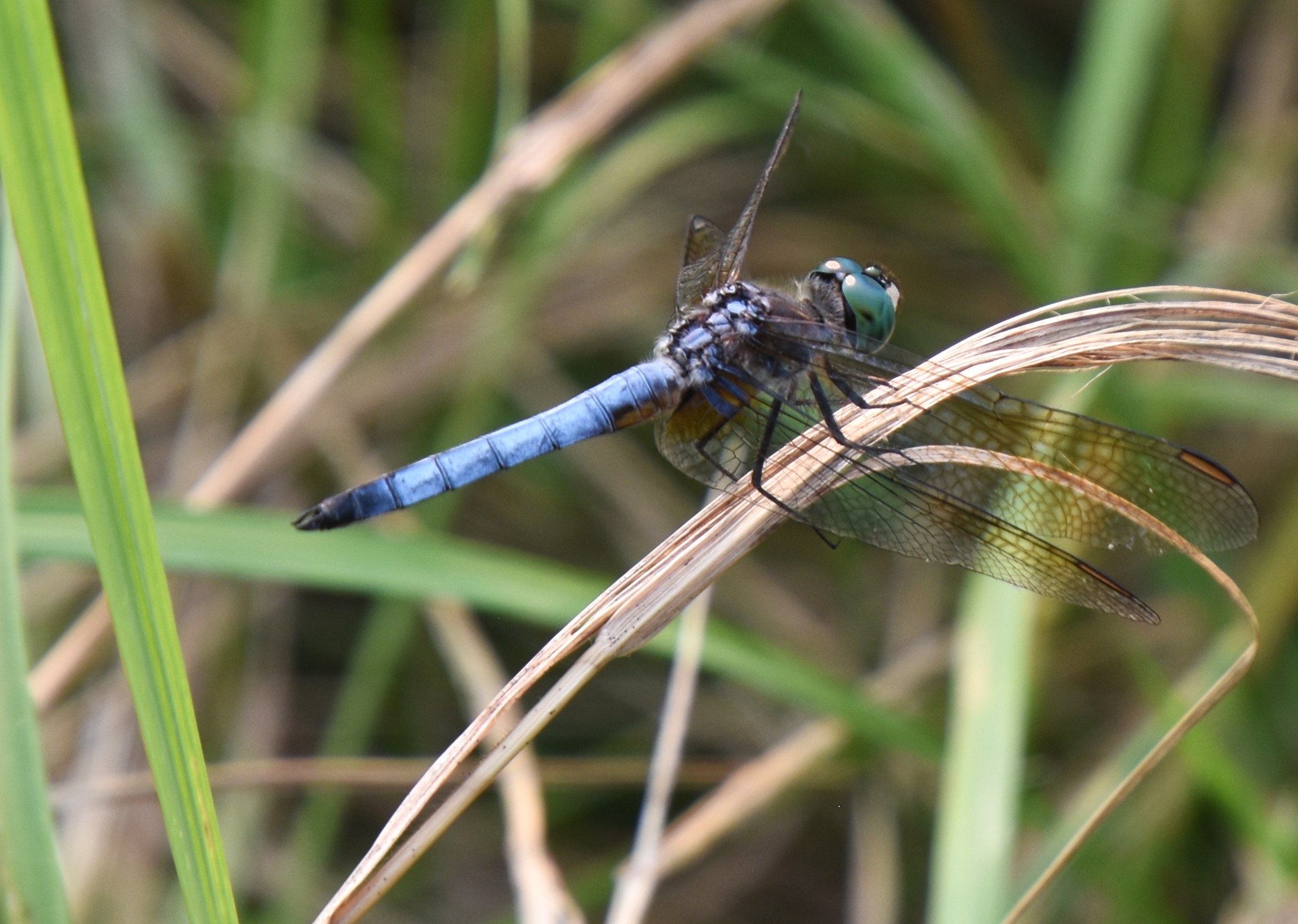
Of particular interest, the Dragonfly Society of the Americas conducted a study in Boise, Idaho, after determining that Blue Dashers seem to be more frequent in disturbed habitats (those inhabited by humans) than less inhabited areas like national parks. Their research so far indicates that Blue Dashers have adapted to the increase in free radicals that organisms are exposed to in built environments, termed “oxidative stress.” This stress can reduce an individual’s fitness, or ability to survive and reproduce, but the Blue Dasher’s genome contains several expanded gene families related to the “response to oxidative stress” compared to other dragonflies of the family Libellulidae, of which it is a member. For more information about this species and the study, please visit the society’s webpage.