
- Conservation
Explore our birding-specific websites:
- Education
- Policy
- Lands
- Centers and EventsCentersEvents
- About Us
Welcome to the newest enhancement of the Silk Farm Sanctuary All Persons Trail. This audio tour provides historical information about the site, ecological information about the surrounding habitats and features, and seasonal information about the wildlife that visits or calls the sanctuary home. We are committed to continue our efforts to protect nature for all people, working to make our programs, lands, and nature centers welcoming, accessible, and equitable to all participants and visitors. This audio tour is a component to that commitment, so that all community members have the opportunity to engage in the experiences that appeal to them.
Audio Trail Stops
Stop 1: Introduction to Silk Farm Wildlife Sanctuary
Stop 2: Bee Hotel
Stop 3: Pollinator Meadow
Stop 4: Knotweed Patch
Stop 5: ORIS
Stop 6: American Chestnut
Stop 7: Grassland Birds
Stop 8: Woodland Birds
Stop 9: Outdoor Classroom
Stop 10: Tree House
Stop 11: Stone Walls
Stop 12: Frogs and Toads
Stop 13: Spongy Moths
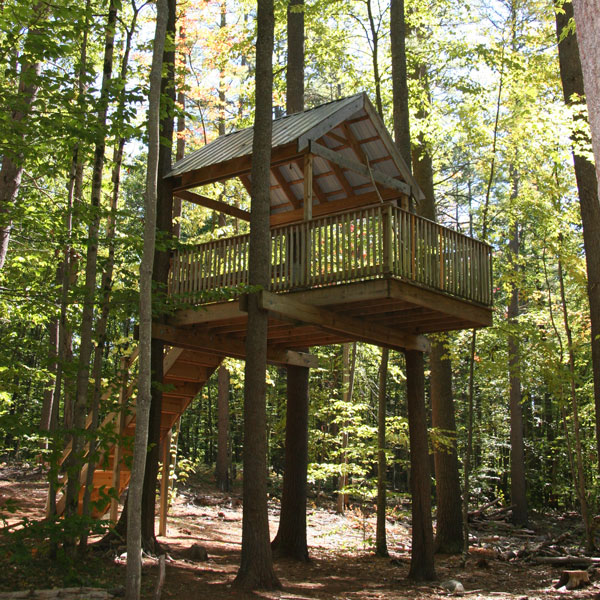
Out from a grove of tall white pine trees emerges an imposing wooden tree house, with a set of stairs leading up to a large platform that overlooks the woods. Young campers have used this tree house for years as a place for imaginative play and as a retreat to be surrounded by nature. Every year, hundreds of kids, age 4 and older, join camps that we hold in winter, during school breaks, and especially over the summer. Campers—and their counselors—learn together about wildlife, plant life, and natural processes over the course of nine week-long summer sessions. Highlights include time spent in our pollinator gardens, on the trails, and at the fire ring.
Visiting Turkey Pond, a 339-acre lake that connects with adjacent Little Turkey Pond, is a great day trip when campers learn about lake ecosystems and aquatic wildlife. Many campers return for multiple weeks so that they can explore a whole range of camp themes about the wonders of New Hampshire’s environment. Campers focus on mammals, birds, insects, amphibians and reptiles. They learn about survival strategies, pollinators, and watersheds and ecosystems. They learn what makes birds unique, how to use maps and compasses, and even the role of nature in art and human creativity.
Reader: Chris Martin
Photos, from top: View across the pollinator meadow, by Dyanna Smith; tree house, by Dyanna Smith.