
(by Pam Hunt)
August is the peak month for shorebird migration, and among the hundreds of sandpipers making their way south from northern breeding grounds are a few that nested right here in New England. This is the Willet, a large species as shorebirds go, and one of only a handful of species that nest in New Hampshire. Here, they are limited to the immediate coast, nesting in salt marshes and foraging on nearby mudflats and shorelines. Despite similar habitats around Great Bay, Willets are still extremely rare on our inland estuary.
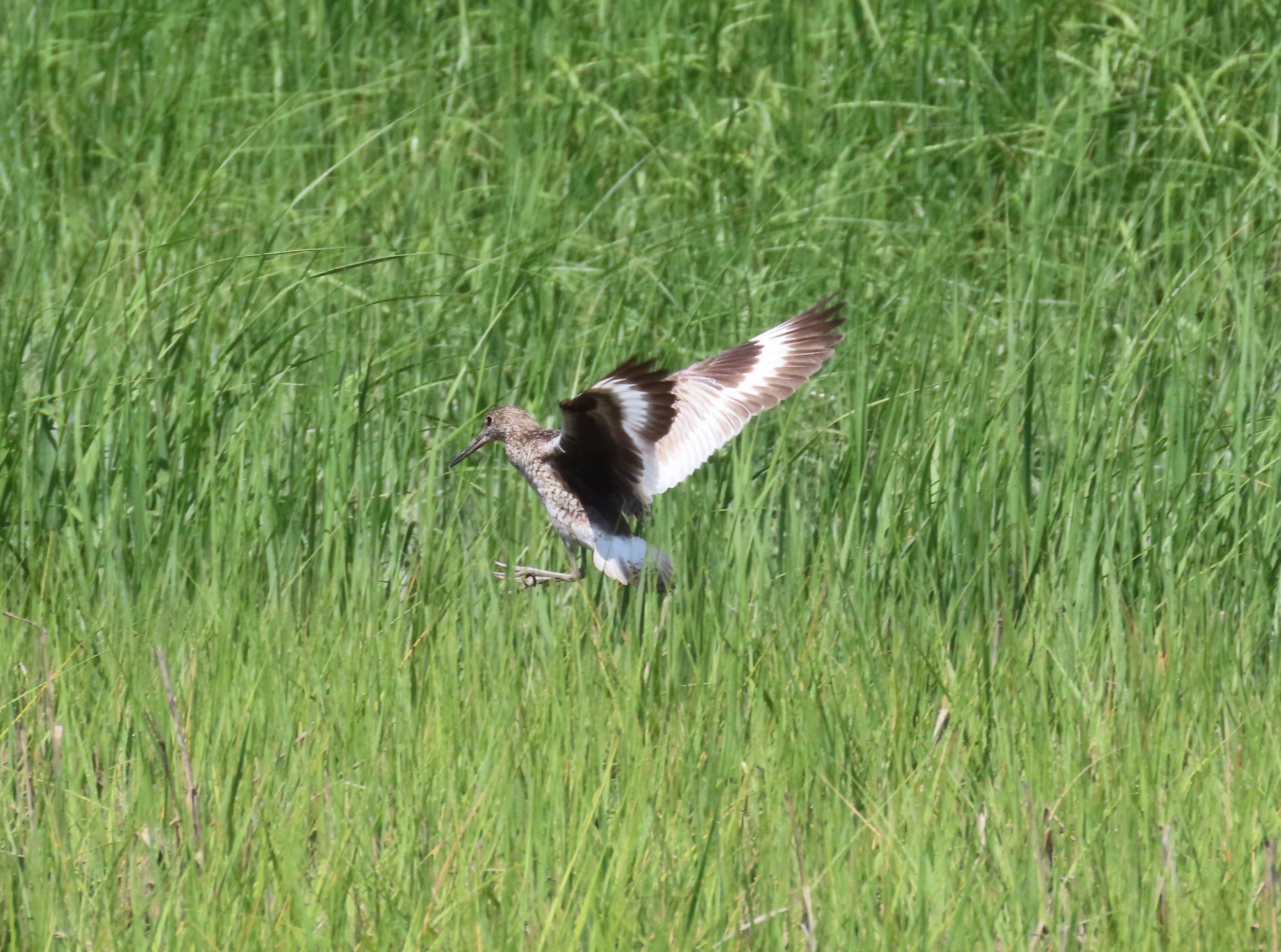
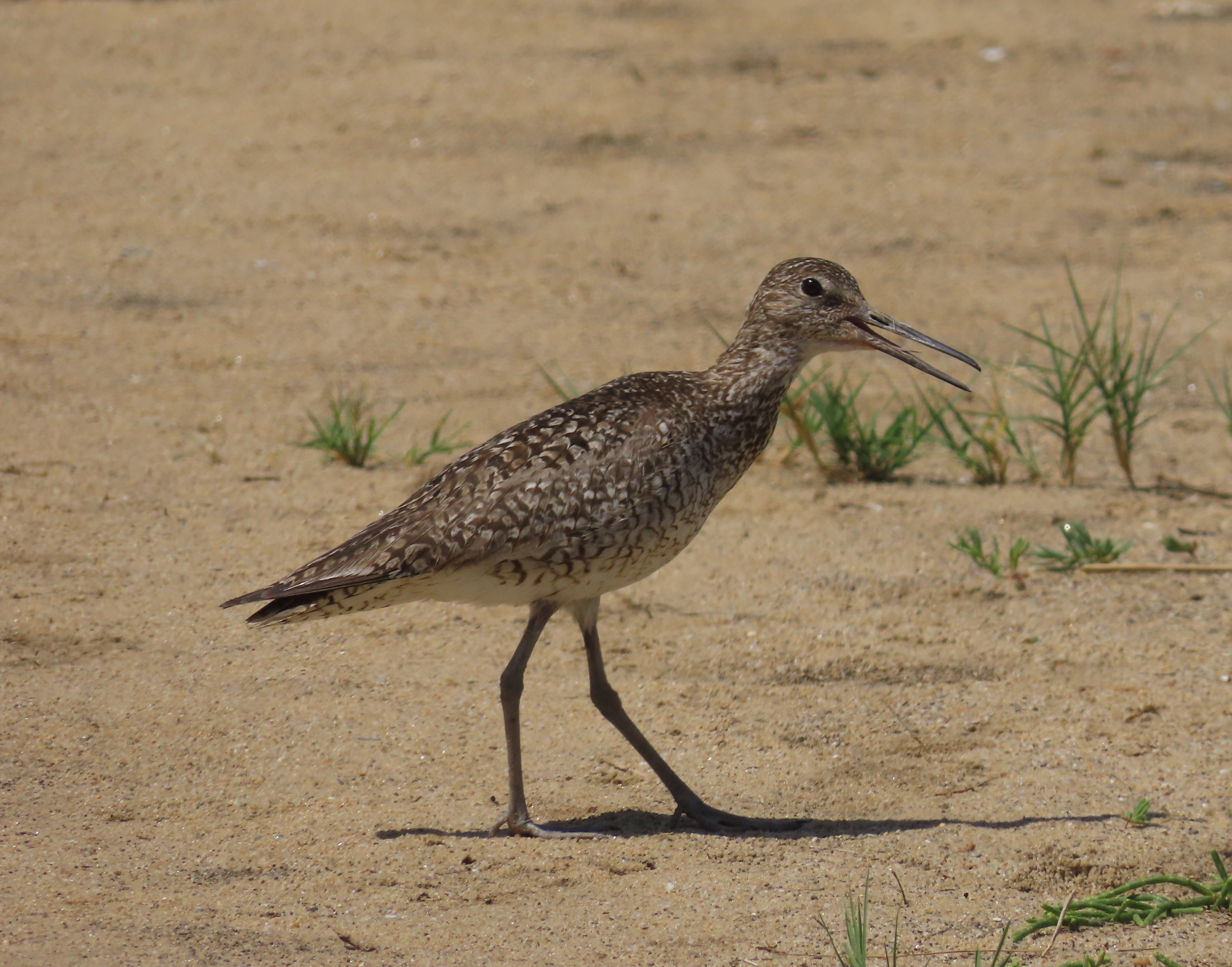
Willets get their name from their loud calls, particularly a loud whistle often rendered as “pill-will-willet.” If you happen to be in a salt marsh and approach a nest, the adults will fearlessly fly straight toward you in defense, calling loudly the entire time, only to veer away at the last minute. Under such circumstances you are also likely to notice the species’ most distinctive field mark: its bold black-and-white wing pattern. When not in flight, the wings are hidden and Willets are patterned in grays and browns like other shorebirds. Note that Willets are noticeably larger than most New Hampshire species however, which can be an aid in identification.
The Willets that nest in coastal habitats in eastern North America are very different from those in the west, which might even be a different species. Western Willets nest in prairie wetlands, but still migrate to coastal areas in winter, including both the Pacific and Gulf of Mexico. At the latter they may co-occur with eastern birds, and there are even scattered records of western birds as far north as New Hampshire in the fall. Eastern Willets winter from the coasts of the southern United States south through the Caribbean to as far as Brazil. Small numbers also nest in the Caribbean, which is unusual for shorebirds.
Like many shorebirds, Willets were heavily hunted prior to protective measures being implemented in the early 1900s. At the same time, heavy human alteration of both coastal and prairie habitats only hastened their decline. They may have been locally extirpated as early as the 1700s, and by 1890 the only breeding site north of the Carolinas was in Nova Scotia. Willets finally began to reappear in New Hampshire in the 1960s as populations to the north and south rebounded and birds were able to fill in previously unoccupied areas of suitable habitat. Today Willets can be found in most significant patches of salt marsh along the New Hampshire coast and seem to be increasing. Although the local population is doing well, the Willet’s reliance on salt marsh habitat makes it vulnerable to threats such as marsh alteration and sea level rise, and it is thus considered a “special concern” species in the state.
State of the Birds at a Glance:
- Habitat: Coastal (salt marsh and beaches)
- Migration: Medium-distance
- Population trend: Increasing
- Threats: Habitat loss, sea level rise
- Conservation actions: Mitigate the effects of sea level rise, minimize disturbance to shorebirds
More information on “The State of New Hampshire’s Birds” is available here. Full species profiles in the format of “Bird of the Month” are now available here.