
(by Pam Hunt)
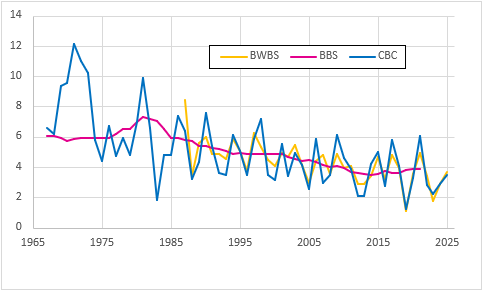
The Blue Jay’s bright colors, loud voice, and in-your-face attitude make it one of the most familiar birds in the eastern United States. Because they are so visible, it is also easier to notice their absence, and backyard birders are quick to get concerned when their jays seem to disappear. This is usually in the winter, but not every winter, and the reason is a simple but little-known fact: Blue Jays migrate. There will always be a few that stay put all year, but others may move as far south as Georgia during their September/October migration period. The number that leaves is tied to the availability of acorns and other nuts in the fall. When these are abundant, more jays remain in New Hampshire for the winter. Those that leave return in April and early May, and you can sometimes see large loose flocks moving north during the day along our major river valleys. Figure 1 shows the ups and downs in our local winter populations quite clearly, and also that these sometimes-dramatic fluctuations are not present in the summer.
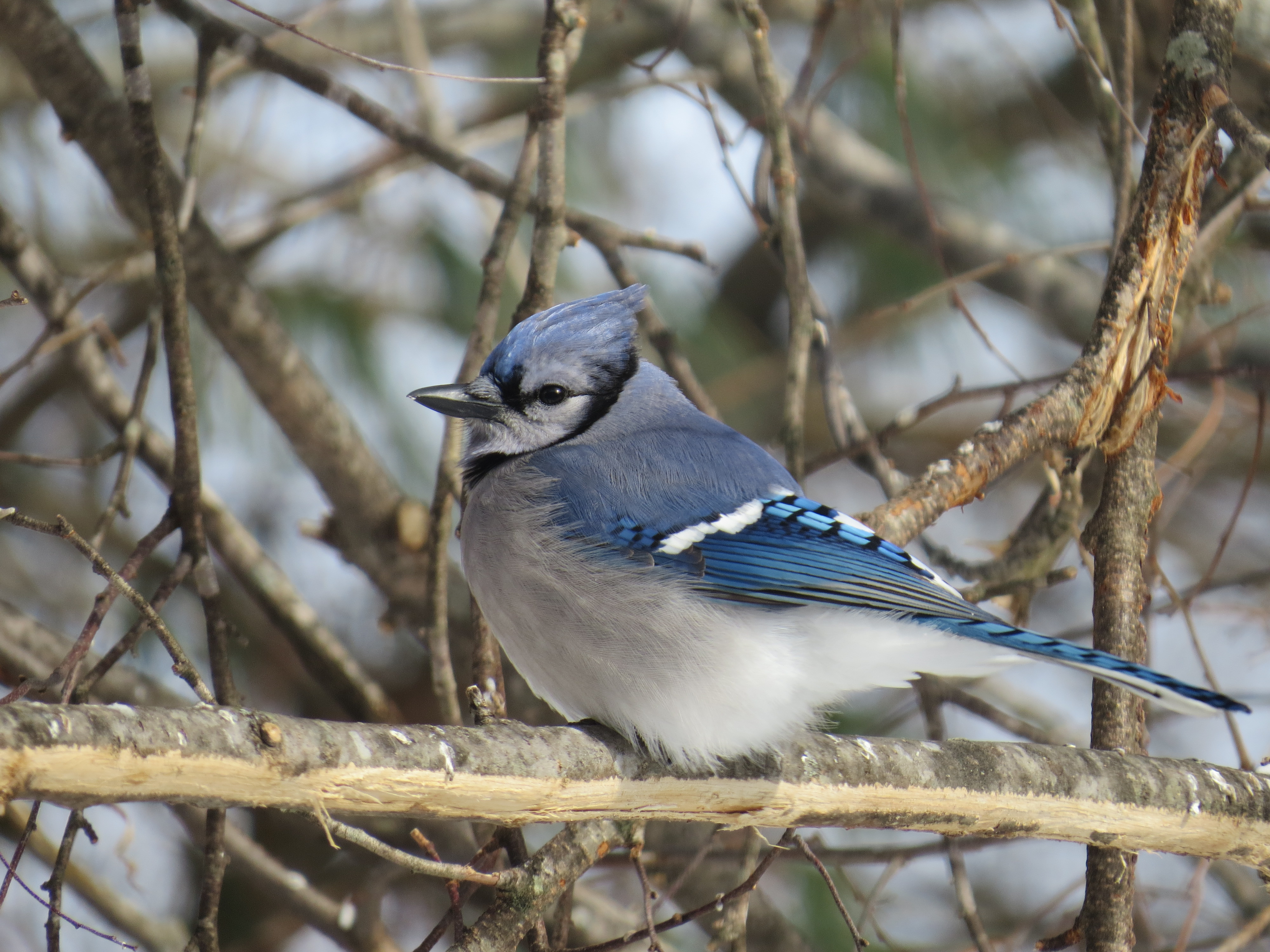 The association of Blue Jays and oaks is so strong that they are believed to be one of the most important means of seed dispersal for these trees (squirrels can’t fly!). One calculation even suggests that the rate at which oaks moved north after the last ice age can be explained via the average distance a Blue Jay travels to cache food. Any acorn stored for later use and then forgotten is a potential oak tree. With a good oak crop in the fall of 2025, expect to see plenty of jays at feeders this winter.
Although most of their diet is nuts and seeds, jays consume insects and other animal prey during the breeding season when seeds are less available. Included here are the eggs and nestlings of other birds, which, as a result, often act aggressively towards jays during the spring and summer. Despite their boisterous demeanor, Blue Jays are usually subordinate to smaller or less imposing species (e.g., cardinals, Mourning Doves) at winter feeders. They still dominate the smallest birds, such as chickadees, earning them the ire of feeder watchers for being bullies.
State of the Birds at a Glance:
- Habitat: Forests, developed areas
- Migration: Short-distance and resident
- Population trend: Decreasing
- Threats: Predation, collisions, disease
- Conservation actions: Maintain a bird-friendly yard
You can help collect valuable data on Blue Jays and other winter birds by participating in NH Audubon’s “Backyard Winter Bird Survey.” The survey will occur on February 14-15, 2026. Visit here for details.
More information on “The State of New Hampshire’s Birds” is available here. Full species profiles in the format of “Bird of the Month” are now available here.