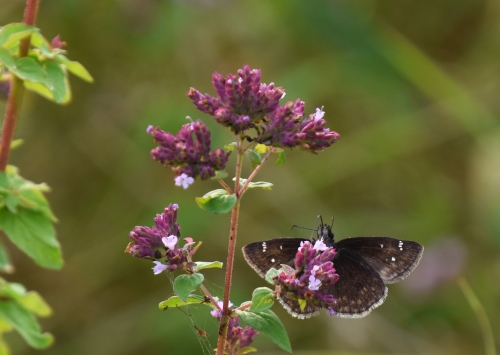
(Photo and article by Anita Fernandez)
You may have noticed these small, brown, winged insects flying around for much of the spring and summer. This is a duskywing, a group of butterflies that are considered skippers. The most common of these, especially in the southern part of the state, is the Wild Indigo Duskywing, which can be seen from April or May all the way until September or October. The skippers are an interesting family of butterflies called Hesperiidae, that have sickle shaped antennae (instead of bulbous or feathery antennae like many other butterflies and moths). If you look to the left of the duskywing’s head in the photo, you can see the curved point of the sickle at the end of the antennae. Although the family of skippers can be difficult to identify (especially the duskywings which tend to be dark, mottled browns), they do have some fun lifestyle and behavioral characteristics. The duskywings that can be found in New Hampshire require certain host plants as caterpillars (like many butterflies and moths), most often tree species like poplar, willow, or oak. The Wild Indigo Duskywing, as you may guess, feeds on Wild Indigo as a caterpillar, but have recently adapted to also eat Crown Vetch, which began being planted extensively as a roadside cover in the 1950s. Male duskywings are very territorial. They will perch on plant stems and dart out to inspect any passersby. If they happen upon another male during these inspections, they engage in a spiraling, defensive flight. Duskywings are also a group of butterflies that overwinter in their larval form, as a caterpillar. Some caterpillars burrow or tuck themselves beneath bark to overwinter, but duskywing larvae use silk to tie themselves into a leaf while it’s still on a tree, falling to the ground with the leaf in the fall, and then emerging from the leaf litter in the spring to begin eating its way to pupation. This is not only an interesting strategy but a good reminder to all of us to leave our leaves until the spring!