
(by Pam Hunt)
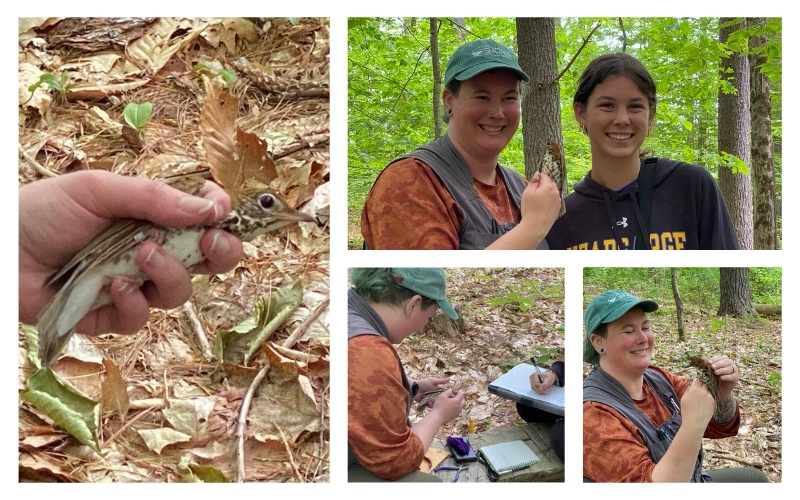
2025 is the second year of the range-wide Wood Thrush tracking project coordinated by the US Fish and Wildlife Service, and NH Audubon and our partners set ourselves an ambitious goal: tagging 34 birds compared to the 27 we caught in 2024. As before, we concentrated our efforts in the vicinity of Motus receiving stations, this year mainly in Albany, Concord, Hancock, Sandwich, and Langdon. As of writing this, only one tag remains to be attached to a thrush, and it’ll likely have been deployed by the team at Tin Mountain Conservation Center by the time you read this. Where data are available, most birds have been detected consistently at the nearest Motus tower through early July, but at least two seem to have made an early move south. These birds, from Walpole and Tin Mountain, were detected at towers in Pennsylvania in mid-July. We had a thrush leave Concord around this time in 2024, and this behavior might indicate a failed nesting attempt. If there are not young to feed, there’s really nothing keeping birds tied to their nesting territories, and sometimes they simply get a head start on fall migration – although usually they only travel a short distance and wait until September to embark on the main journey. It’s through projects like this that we’ll hopefully unlock more such secrets of Wood Thrush migration in North America!
Meanwhile, of the 27 birds tagged in 2024, at least nine returned to the same territories this spring, generally arriving the first week of May. Another five were detected on their way north, and it’s possible they’re back on site in NH undetected. We hope to check on more of last year’s birds in the coming weeks to see if we can find any more. And with luck, these older tags might last just long enough to collect data on a second southbound migration for these birds. Will they take similar routes? Stay tuned to find out. And as always, thanks to our partners at Tim Mountain, Antioch University, and the Harris Center for their valuable help in making this project truly a statewide endeavor.